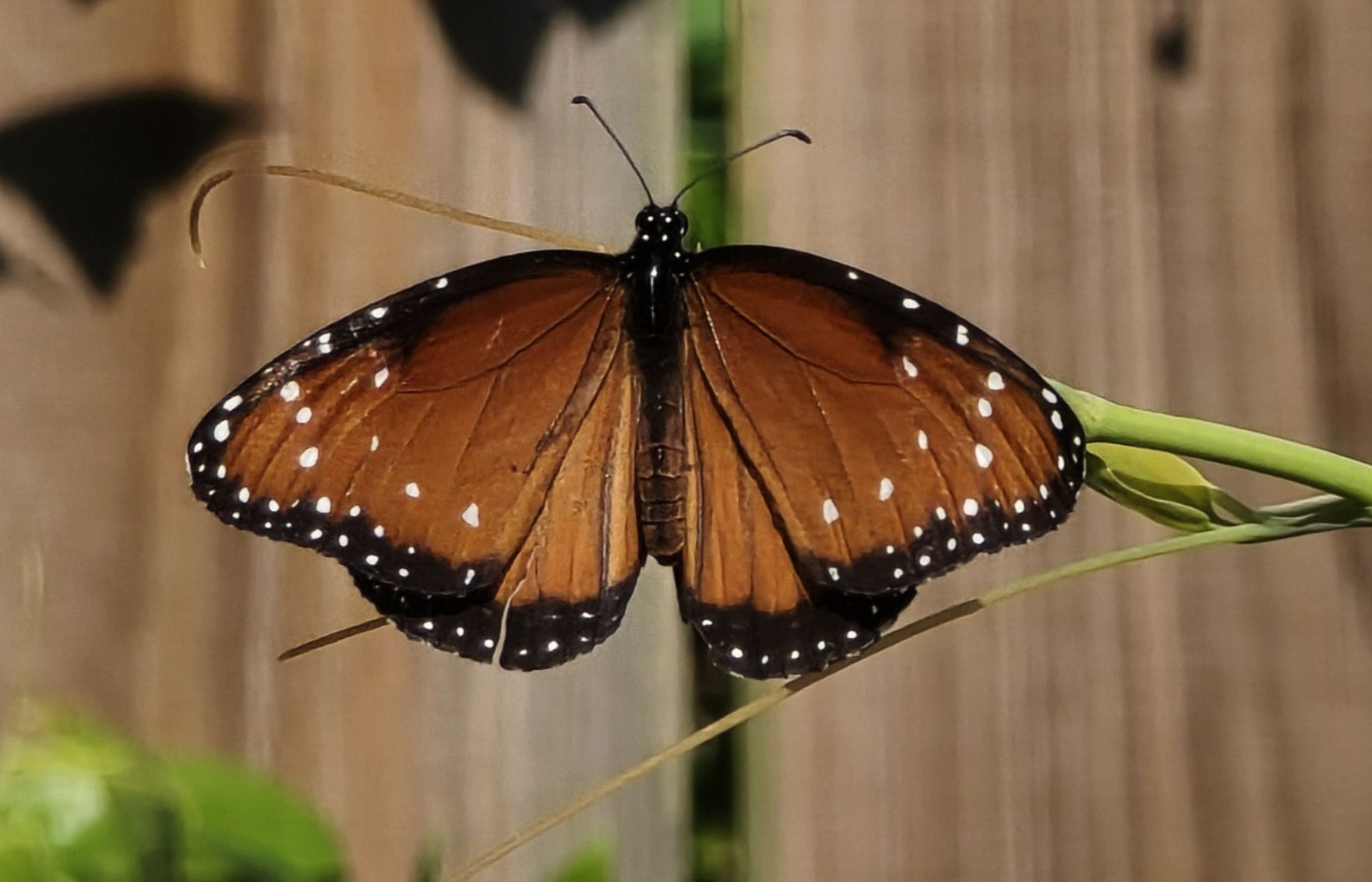
 I’m embarking on a new (yet another) adventure. I am hoping to create my own nursery of milkweeds (North American varieties only). Living in Florida and being an insect enthusiast has led me to this. Here in Florida we have a problem with milkweed and it’s rather worrying. The problem may spread farther than Florida’s borders, so this could affect many readers. First, native milkweed is not the plentiful, ubiquitous “weed” that it once was. It’s not easy to find, either on roadsides, ditches, or in stores. Monarchs have few choices. What we do have plenty of are big box stores willing to sell us non-native milkweed plants that are contributing to a Monarch protozoa infestation. The protozoa is Ophryocystis elektroscirrha, otherwise known as “OE”.
I won’t go into all of the reproductive details about OE, as this has been well documented at Project Monarch Health. What I can relay is that this is a serious problem not just in South Florida but in northeast Florida as well. The spores are heavy on the Asclepias curassavica, and that is the number one milkweed plant sold at retail nurseries. I have a microscope at home so that I can test my plants and any dead/dying monarchs I may find. I will be writing up another post on how I test.
Now, I know that I should get rid of my A. curassavica, and soon. I’m on a mission to get rid of all of these plants in my yard. This becomes more important as I am currently growing many other species of milkweed such as A. tuberosa, A. perennis, A. incarnata, A. verticillata, and A. viridis. My concern is that the protozoa will end up on these plants as well since most of the monarch butterflies in my yard are probably infected. And what if I decide to share these plants and their seeds with other people? I will need to consult with some people who are far smarter than I am in this regard to find out if I am doing more damage by growing these milkweed species near infected butterflies. If so, how can I remedy the situation?
Ultimately, I would love to create a plant nursery where I grow and sell nothing but butterfly host and nectar plants. I would really like to focus mainly on the host plants. Without those, there are few butterflies that stick around. But I want to do this safely, ecologically speaking. I want to be part of a solution, not a problem. In my dream world, I see 4 acres of shade houses where I safely grow a sea of plants for nothing but pollinators. Some plants would be used solely for seed, so I would have to leave some plants available to the insects, about 1 acre. There would be no pesticides whatsoever. The plant species would be tracked and labelled accurately, unlike so many of the big box nurseries that have sold A. curassavica under the incorrect label as A. tuberosa. Also, being in Florida and knowing that OE is a problem, would it be safe for me to sell plants out of state? I think that so long as the plants die back in the winter, then the OE problem will die as well. My nursery would have absolutely no currasavica, or any other milkweed species that does not die back in the winter.
Armed with what little knowledge I have and tons of questions, I at least now have a starting point. First, learn about various species of milkweeds. To narrow that down, I’m going to focus on milkweed that is native to the Southeastern US.
Second, I will try to grow what I can, but finding seeds will not be easy. I currently have the following growing in my nursery:
A. incarnata
A. speciosa
A. tuberosa
A. verticillata
A. viridis
A. perennis
 Buzzing Blossoms